Baby Is Referred to as an Embryo for the Period
| Embryo | |
|---|---|
 A male human embryo, 7 weeks old | |
| Identifiers | |
| TE | E1.0.2.6.four.0.5 |
| Anatomical terminology [edit on Wikidata] | |
An embryo is the early on stage of evolution of a multicellular organism. In general, in organisms that reproduce sexually, embryonic development is the part of the life cycle that begins just afterwards fertilization and continues through the formation of body structures, such as tissues and organs. Each embryo starts development as a zygote, a single prison cell resulting from the fusion of gametes (i.e. the process of fertilization which is the fusion of a female egg cell and a male sperm cell). In the first stages of embryonic development, a unmarried-celled zygote undergoes many rapid prison cell divisions, chosen cleavage, to form a blastula, which looks similar to a ball of cells. Next, the cells in a blastula-stage embryo starting time rearranging themselves into layers in a procedure called gastrulation. These layers volition each requite rise to different parts of the developing multicellular organism, such as the nervous arrangement, connective tissue, and organs.
A newly developing homo is typically referred to as an embryo until the ninth week after conception, when information technology is and then referred to equally a fetus. In other multicellular organisms, the word "embryo" tin be used more than broadly to any early developmental or life cycle stage prior to nativity or hatching.
Etymology [edit]
First attested in English in the mid-14c., the word embryon derives from Medieval Latin embryo, itself from Greek ἔμβρυον (embruon), lit. "young ane",[1] which is the neuter of ἔμβρυος (embruos), lit. "growing in",[two] from ἐν (en), "in"[iii] and βρύω (bruō), "dandy, be full";[4] the proper Latinized form of the Greek term would be embryum.
Development [edit]
Animal embryos [edit]
Embryonic development of salamander, circa the 1920s

Embryos (and one tadpole) of the wrinkled frog (Rana rugosa)
In animals, fertilization begins the process of embryonic development with the creation of a zygote, a single jail cell resulting from the fusion of gametes (due east.g. egg and sperm).[5] The development of a zygote into a multicellular embryo proceeds through a series of recognizable stages, ofttimes divided into cleavage, blastula, gastrulation, and organogenesis.[half-dozen]
Cleavage is the period of rapid mitotic prison cell divisions that occur after fertilization. During cleavage, the overall size of the embryo does non change, but the size of private cells decrease rapidly as they divide to increment the total number of cells.[7] Cleavage results in a blastula.[6]
Depending on the species, a blastula stage embryo tin can announced every bit a brawl of cells on meridian of yolk, or as a hollow sphere of cells surrounding a middle cavity.[eight] The embryo's cells go along to divide and increase in number, while molecules within the cells such as RNAs and proteins actively promote key developmental processes such as cistron expression, cell fate specification, and polarity.[9]
Gastrulation is the adjacent stage of embryonic development, and involves the development of ii or more layers of cells (germinal layers). Animals that form two layers (such as Cnidaria) are called diploblastic, and those that form three (most other animals, from flatworms to humans) are called triploblastic. During gastrulation of triploblastic animals, the 3 germinal layers that grade are called the ectoderm, mesoderm, and endoderm.[eight] All tissues and organs of a mature animate being can trace their origin back to i of these layers.[10] For case, the ectoderm will requite ascension to the pare epidermis and the nervous organization,[xi] the mesoderm will give rise to the vascular system, muscles, bone, and connective tissues,[12] and the endoderm will give rise to organs of the digestive arrangement and epithelium of the digestive system and respiratory system.[xiii] [14] Many visible changes in embryonic structure happen throughout gastrulation equally the cells that brand up the different germ layers migrate and cause the previously round embryo to fold or invaginate into a cup-similar appearance.[viii]
Past gastrulation, an embryo continues to develop into a mature multicellular organism by forming structures necessary for life outside of the womb or egg. Equally the name suggests, organogenesis is the stage of embryonic development when organs form. During organogenesis, molecular and cellular interactions prompt sure populations of cells from the different germ layers to differentiate into organ-specific cell types.[xv] For instance, in neurogenesis, a subpopulation of cells from the ectoderm segregate from other cells and further specialize to become the brain, spinal string, or peripheral fretfulness.[16]
The embryonic catamenia varies from species to species. In human evolution, the term fetus is used instead of embryo later on the ninth calendar week after conception,[17] whereas in zebrafish, embryonic development is considered finished when a bone called the cleithrum becomes visible.[18] In animals that hatch from an egg, such as birds, a young animate being is typically no longer referred to as an embryo once information technology has hatched. In vivaparous animals (animals whose offspring spend at least some fourth dimension developing within a parent's body), the offspring is typically referred to as an embryo while inside of the parent, and is no longer considered an embryo afterwards birth or leave from the parent. However, the extent of development and growth accomplished while inside of an egg or parent varies significantly from species to species, so much so that the processes that take place after hatching or birth in ane species may have place well before those events in another. Therefore, according to one textbook, it is common for scientists interpret the scope of embryology broadly as the study of the evolution of animals.[8]
Establish embryos [edit]
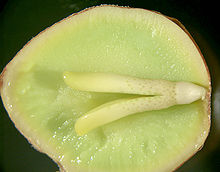
The inside of a Ginkgo seed, showing the embryo
Flowering plants (angiosperms) create embryos after the fertilization of a haploid ovule by pollen. The DNA from the ovule and pollen combine to form a diploid, single-cell zygote that volition develop into an embryo.[19] The zygote, which will split up multiple times as it progresses throughout embryonic evolution, is one function of a seed. Other seed components include the endosperm, which is tissue rich in nutrients that will help back up the growing plant embryo, and the seed glaze, which is a protective outer covering. The first cell division of a zygote is disproportionate, resulting in an embryo with one small-scale cell (the upmost cell) and i large cell (the basal jail cell).[20] The minor, apical prison cell will eventually requite ascent to most of the structures of the mature plant, such every bit the stem, leaves, and roots.[21] The larger basal cell will give rise to the suspensor, which connects the embryo to the endosperm so that nutrients can laissez passer between them.[20] The plant embryo cells continue to carve up and progress through developmental stages named for their full general appearance: globular, heart, and torpedo. In the globular stage, 3 basic tissue types (dermal, ground, and vascular) tin exist recognized.[xx] The dermal tissue will give rising to the epidermis or outer roofing of a plant,[22] ground tissue will give rising to inner plant fabric that functions in photosynthesis, resource storage, and physical back up,[23] and vascular tissue will give rise to connective tissue similar the xylem and phloem that transport fluid, nutrients, and minerals throughout the found.[24] In heart stage, one or two cotyledons (embryonic leaves) will grade. Meristems (centers of stem prison cell activeness) develop during the torpedo stage, and volition eventually produce many of the mature tissues of the adult establish throughout its life.[20] At the end of embryonic growth, the seed will usually go dormant until formation.[25] Once the embryo begins to germinate (grow out from the seed) and forms its first true foliage, information technology is called a seedling or plantlet.[26]
Plants that produce spores instead of seeds, similar bryophytes and ferns, besides produce embryos. In these plants, the embryo begins its beingness fastened to the inside of the archegonium on a parental gametophyte from which the egg cell was generated.[27] The inner wall of the archegonium lies in close contact with the "foot" of the developing embryo; this "pes" consists of a bulbous mass of cells at the base of the embryo which may receive nutrition from its parent gametophyte.[28] The structure and evolution of the residual of the embryo varies by group of plants.[29]
Since all country plants create embryos, they are collectively referred to as embryophytes (or by their scientific name, Embryophyta). This, along with other characteristics, distinguishes country plants from other types of plants, such as algae, which exercise not produce embryos.[30]
Enquiry and applied science [edit]
Biological processes [edit]
Embryos from numerous plant and animal species are studied in biological inquiry laboratories beyond the globe to learn about topics such equally stem cells,[31] development and development,[32] prison cell sectionalization,[33] and gene expression.[34] Examples of scientific discoveries made while studying embryos that were awarded the Nobel Prize in Physiology or Medicine include the Spemann-Mangold organizer, a group of cells originally discovered in amphibian embryos that give ascension to neural tissues,[35] and genes that give ascension to trunk segments discovered in Drosophila fly embryos by Christiane Nüsslein-Volhard and Eric Wieschaus.[36]
Assisted reproductive technology [edit]
Creating and/or manipulating embryos via assisted reproductive technology (ART) is used for addressing fertility concerns in humans and other animals, and for selective breeding in agricultural species. Between the years 1987 and 2015, Fine art techniques including in vitro fertilization (IVF) were responsible for an estimated 1 million human births in the Us lonely.[37] Other clinical technologies include preimplantation genetic diagnosis (PGD), which can identify certain serious genetic abnormalities, such as aneuploidy, prior to selecting embryos for use in IVF.[38] Some have proposed (or even attempted - run across He Jiankui affair) genetic editing of human embryos via CRISPR-Cas9 as a potential artery for preventing disease;[39] notwithstanding, this has been met with widespread condemnation from the scientific community.[40] [41]
Fine art techniques are also used to improve the profitability of agricultural animal species such as cows and pigs past enabling selective breeding for desired traits and/or to increment numbers of offspring.[42] For instance, when allowed to breed naturally, cows typically produce ane calf per yr, whereas IVF increases offspring yield to 9-12 calves per year.[43] IVF and other ART techniques, including cloning via interspecies somatic cell nuclear transfer (iSCNT),[44] are too used in attempts to increment the numbers of endangered or vulnerable species, such as Northern white rhinos,[45] cheetahs,[46] and sturgeons.[47]
Cryoconservation of plant and animal biodiversity [edit]
Cryoconservation of genetic resources involves collecting and storing the reproductive materials, such as embryos, seeds, or gametes, from animal or plant species at low temperatures in order to preserve them for hereafter use.[48] Some large-scale brute species cryoconservation efforts include "frozen zoos" in various places around the world, including in the Great britain's Frozen Ark,[49] the Breeding Centre for Endangered Arabian Wildlife (BCEAW) in the United Arab Emirates,[50] and the San Diego Zoo Found for Conservation in the United States.[51] [52] As of 2018, there were approximately 1,700 seed banks used to store and protect plant biodiversity, particularly in the event of mass extinction or other global emergencies.[53] The Svalbard Global Seed Vault in Norway maintains the largest collection of plant reproductive tissue, with more than a million samples stored at −xviii °C (0 °F).[54]
Fossilized embryos [edit]
Fossilized animal embryos are known from the Precambrian, and are found in great numbers during the Cambrian period. Fifty-fifty fossilized dinosaur embryos take been discovered.[55]
Run into besides [edit]
- Embryo loss
- Plant embryogenesis
- Pregnancy
- Prenatal development
- In vitro fecundation
- Proembryo
- Miscarriage
- Abortion
Notes [edit]
- ^ ἔμβρυον Archived 2013-05-31 at the Wayback Automobile, Henry George Liddell, Robert Scott, A Greek-English language Lexicon, on Perseus
- ^ ἔμβρυος Archived 2013-05-31 at the Wayback Machine, Henry George Liddell, Robert Scott, A Greek-English Lexicon, on Perseus
- ^ ἐν Archived 2013-05-31 at the Wayback Machine, Henry George Liddell, Robert Scott, A Greek-English Lexicon, on Perseus
- ^ βρύω Archived 2013-05-31 at the Wayback Automobile, Henry George Liddell, Robert Scott, A Greek-English language Lexicon, on Perseus
- ^ Molnar, Charles (14 May 2015). "24.6. Fertilization and Early Embryonic Evolution – Concepts of Biology – 1st Canadian Edition". opentextbc.ca . Retrieved 2019-x-30 .
- ^ a b Gilbert, Scott F. (2000). "The Circle of Life: The Stages of Brute Development". Developmental Biology. 6th Edition.
- ^ "DevBio 11e". 11e.devbio.com . Retrieved 2019-11-07 .
- ^ a b c d Balinsky, Boris Ivan (1975). An Introduction to Embryology (Fourth ed.). West.B. Saunders Company. ISBN0-7216-1518-X.
- ^ Heasman, Janet (2006-04-01). "Patterning the early Xenopus embryo". Development. 133 (7): 1205–1217. doi:10.1242/dev.02304. ISSN 0950-1991. PMID 16527985.
- ^ Favarolo, María Belén; López, Silvia L. (2018-12-01). "Notch signaling in the division of germ layers in bilaterian embryos". Mechanisms of Development. 154: 122–144. doi:10.1016/j.modern.2018.06.005. ISSN 0925-4773. PMID 29940277.
- ^ "Ectoderm | The Embryo Project Encyclopedia". embryo.asu.edu . Retrieved 2019-eleven-07 .
- ^ "Mesoderm | The Embryo Projection Encyclopedia". embryo.asu.edu . Retrieved 2019-11-07 .
- ^ Zorn, Aaron M.; Wells, James M. (2009). "Vertebrate Endoderm Development and Organ Formation". Almanac Review of Cell and Developmental Biology. 25: 221–251. doi:ten.1146/annurev.cellbio.042308.113344. ISSN 1081-0706. PMC2861293. PMID 19575677.
- ^ Nowotschin, Sonja; Hadjantonakis, Anna-Katerina; Campbell, Kyra (2019-06-01). "The endoderm: a divergent cell lineage with many commonalities". Development. 146 (11): dev150920. doi:10.1242/dev.150920. ISSN 0950-1991. PMC6589075. PMID 31160415.
- ^ "Process of Eukaryotic Embryonic Development | The Embryo Project Encyclopedia". embryo.asu.edu . Retrieved 2019-eleven-07 .
- ^ Hartenstein, Volker; Stollewerk, Angelika (2015-02-23). "The Development of Early Neurogenesis". Developmental Cell. 32 (4): 390–407. doi:x.1016/j.devcel.2015.02.004. ISSN 1534-5807. PMC5987553. PMID 25710527.
- ^ "Embryo vs. Fetus: The First 27 Weeks of Pregnancy". MedicineNet . Retrieved 2019-11-07 .
- ^ Kimmel, Charles B.; Ballard, William West.; Kimmel, Seth R.; Ullmann, Bonnie; Schilling, Thomas F. (1995). "Stages of embryonic evolution of the zebrafish". Developmental Dynamics. 203 (three): 253–310. doi:x.1002/aja.1002030302. ISSN 1097-0177. PMID 8589427. S2CID 19327966.
- ^ "seed | Form, Function, Dispersal, & Germination". Encyclopedia Britannica . Retrieved 2019-11-09 .
- ^ a b c d "Chapter 12A. Plant Development". biology.kenyon.edu . Retrieved 2019-11-09 .
- ^ Hove, Colette A. ten; Lu, Kuan-Ju; Weijers, Dolf (2015-02-01). "Building a plant: cell fate specification in the early Arabidopsis embryo". Development. 142 (3): 420–430. doi:10.1242/dev.111500. ISSN 0950-1991. PMID 25605778.
- ^ "| CK-12 Foundation". www.ck12.org . Retrieved 2019-11-09 .
- ^ "GLOSSARY G". www2.estrellamountain.edu . Retrieved 2019-11-09 .
- ^ "Vascular Tissue". Biology Dictionary. 2018-05-21. Retrieved 2019-eleven-09 .
- ^ Penfield, Steven (2017-09-11). "Seed dormancy and germination". Electric current Biology. 27 (17): R874–R878. doi:x.1016/j.cub.2017.05.050. ISSN 0960-9822. PMID 28898656.
- ^ "Germination and Seedling Emergence". Forage Information System. 2016-03-28. Retrieved 2019-11-09 .
- ^ "Life Bicycle - in a nutshell - bryophyte". www.anbg.gov.au . Retrieved 2019-11-14 .
- ^ "Plant evolution - Nutritional dependence of the embryo". Encyclopedia Britannica . Retrieved 2019-eleven-14 .
- ^ Clark, Mary Ann (5 March 2018). "Bryophytes – Biology 2e". opentextbc.ca . Retrieved 2019-11-xiv .
- ^ "What are seaweeds?". formosa.ntm.gov.tw . Retrieved 2019-11-09 .
- ^ Mummery, Christine; van de Stolpe, Anja; Roelen, Bernard A. J.; Clevers, Hans, eds. (2014-01-01), "Chapter 4 - Of Mice and Men: The History of Embryonic Stem Cells", Stem Cells (Second Edition), Academic Press, pp. 69–100, doi:10.1016/B978-0-12-411551-iv.00004-0, ISBN9780124115514 , retrieved 2019-11-14
- ^ Martín-Durán, José K.; Monjo, Francisco; Romero, Rafael (2012). "Planarian embryology in the era of comparative developmental biology". The International Periodical of Developmental Biology. 56 (1–3): 39–48. doi:10.1387/ijdb.113442jm. ISSN 1696-3547. PMID 22450993.
- ^ Kumar, Megha; Pushpa, Kumari; Mylavarapu, Sivaram Five. S. (July 2015). "Splitting the cell, building the organism: Mechanisms of prison cell division in metazoan embryos". IUBMB Life. 67 (7): 575–587. doi:ten.1002/iub.1404. ISSN 1521-6551. PMC5937677. PMID 26173082.
- ^ Jukam, David; Shariati, S. Ali Yard.; Skotheim, Jan M. (2017-08-21). "Zygotic Genome Activation in Vertebrates". Developmental Prison cell. 42 (four): 316–332. doi:10.1016/j.devcel.2017.07.026. ISSN 1878-1551. PMC5714289. PMID 28829942.
- ^ "Spemann-Mangold Organizer | The Embryo Project Encyclopedia". embryo.asu.edu . Retrieved 2019-11-fourteen .
- ^ "The Nobel Prize in Physiology or Medicine 1995". NobelPrize.org . Retrieved 2019-11-fourteen .
- ^ "IVF by the Numbers – Penn Medicine". www.pennmedicine.org . Retrieved 2020-04-15 .
- ^ Basille, Claire; Frydman, René; El Aly, Abdelwahab; Hesters, Laetitia; Fanchin, Renato; Tachdjian, Gérard; Steffann, Julie; LeLorc'h, Marc; Achour-Frydman, Nelly (July 2009). "Preimplantation genetic diagnosis: state of the fine art". European Journal of Obstetrics, Gynecology, and Reproductive Biology. 145 (i): nine–xiii. doi:10.1016/j.ejogrb.2009.04.004. ISSN 1872-7654. PMID 19411132.
- ^ "New U.S. Experiments Aim To Create Gene-Edited Human Embryos". NPR.org . Retrieved 2020-04-xv .
- ^ Cyranoski, David; Ledford, Heidi (2018-11-26). "Genome-edited babe claim provokes international outcry". Nature. 563 (7733): 607–608. Bibcode:2018Natur.563..607C. doi:10.1038/d41586-018-07545-0. PMID 30482929. S2CID 53768039.
- ^ "Experts Are Calling for a Ban on Gene Editing of Homo Embryos. Here'southward Why They're Worried". Fourth dimension . Retrieved 2020-04-xv .
- ^ Blondin, P. (January 2016). "Logistics of large scale commercial IVF embryo product". Reproduction, Fertility, and Development. 29 (one): 32–36. doi:ten.1071/RD16317. ISSN 1031-3613. PMID 28278791.
- ^ "Agronomics for Impact Embryo Transfer". Retrieved 2020-04-15 .
- ^ Fletcher, Amy Lynn (2014). "Bio-Interventions: Cloning Endangered Species as Wildlife Conservation". In Fletcher, Amy Lynn (ed.). Mendel'south Ark. Mendel'south Ark: Biotechnology and the Future of Extinction. Springer Netherlands. pp. 49–66. doi:10.1007/978-94-017-9121-2_4. ISBN978-94-017-9121-2.
- ^ Sample, Ian (2019-09-11). "Scientists use IVF procedures to assistance save near-extinct rhinos". The Guardian. ISSN 0261-3077. Retrieved 2020-04-15 .
- ^ Lee, Alicia. "Two chetah cubs were born for the starting time time past IVF. The breakthrough offers promise for the threatened species". CNN . Retrieved 2020-04-fifteen .
- ^ Fatira, Effrosyni; Havelka, Miloš; Labbé, Catherine; Depincé, Alexandra; Iegorova, Viktoriia; Pšenička, Martin; Saito, Taiju (2018-04-16). "Application of interspecific Somatic Cell Nuclear Transfer (iSCNT) in sturgeons and an unexpectedly produced gynogenetic sterlet with homozygous quadruple haploid". Scientific Reports. viii (1): 5997. Bibcode:2018NatSR...eight.5997F. doi:10.1038/s41598-018-24376-1. ISSN 2045-2322. PMC5902484. PMID 29662093.
- ^ "The Role of Biotechnology in Exploring and Protecting Agricultural Genetic Resource". www.fao.org . Retrieved 2020-04-xv .
- ^ "Frozen Ark".
- ^ "Breeding Centre for Endangered Arabian Wildlife". www.bceaw.ae . Retrieved 2020-04-15 .
- ^ "Frozen Zoo®". San Diego Zoo Found for Conservation Research. 2016-01-26. Retrieved 2020-04-xv .
- ^ "San Diego's Frozen Zoo Offers Hope for Endangered Species Around the World". Smithsonian Magazine . Retrieved 2020-04-15 .
- ^ "A vast crypt was congenital to protect humans from the apocalypse. But doomsday might already be here". The Independent. 2018-03-04. Retrieved 2020-04-15 .
- ^ "Svalbard Global Seed Vault". Crop Trust . Retrieved 2020-04-15 .
- ^ Morelle, Rebecca. "Dinosaur embryo fossils reveal life inside the egg". BBC News. Archived from the original on 24 September 2015. Retrieved 8 August 2015.
External links [edit]
 | Wikimedia Commons has media related to Embryos. |
 | Wikiquote has quotations related to: Embryo |
- UNSW Embryology - Educational website
- A Comparative Embryology Gallery
- 4-H Embryology, University of Nebraska-Lincoln Extension in Lancaster County
- Video with embryo of a small-spotted catshark inside the egg on YouTube
Source: https://en.wikipedia.org/wiki/Embryo

Post a Comment for "Baby Is Referred to as an Embryo for the Period"